


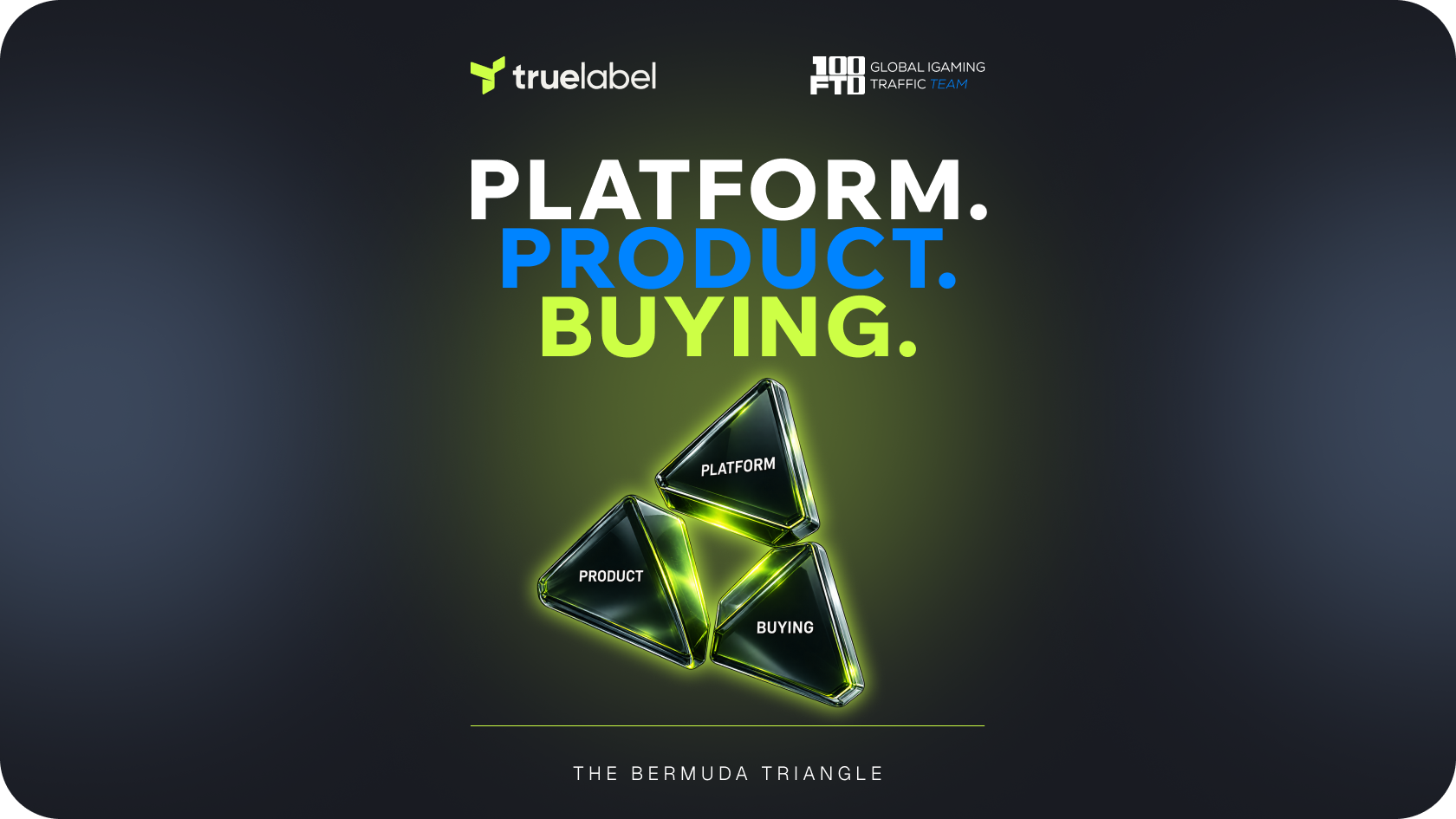
In the iGaming Bermuda Triangle, ships do not disappear. What disappears is the cause-and-effect relationship between a click, a deposit and player value — and with it, budget, time and accountability for the result.
The way out of this Bermuda Triangle is not through a greater number of separate reports, but through bringing context together. A signal from the traffic side needs to be matched with player behaviour, turned into a testable hypothesis, implemented at the product or platform level, and returned to a controlled test.
This is exactly how the collaboration between True Label, the brand and 100FTD is structured: signal → context → hypothesis → change → controlled retest. True Label turns validated feedback into a technical or product solution, 100FTD validates it with traffic, while the brand connects buying and product data around the behaviour of the real player. The goal is not to identify the party responsible for a weak result, but to determine what needs to be stopped, what needs to be changed, and what is already ready to scale.
Three Sides, One Funnel
Question for 100FTD: Who is 100FTD, what does the team do, and how many years has it been operating in the market?
100FTD answer:
100FTD is an international iGaming traffic team that has been helping brands launch, test and scale advertising campaigns since 2017. Over this time, we have built practical expertise working with different GEOs, traffic sources and product models.
Our main traffic sources are Meta Ads and In-App. Depending on the objectives and specifics of a project, we also use SEO, SMS, Push and Email channels. Within 100FTD, we combine expertise in media buying, analytics, creative production, technical support and partner management. This allows us to manage a campaign as one integrated process — from developing hypotheses and advertising materials to launch, optimisation and scaling.
The main tasks we cover are launching and managing advertising campaigns, testing GEOs, offers, funnels and creative approaches, finding effective combinations and subsequently scaling them. We adapt each campaign to the specifics of the particular market, audience and product, because the same acquisition model cannot work equally well under different conditions.
Question for 100FTD: How does your approach differ from the standard model of “received the budget — launched traffic — delivered a report”?
100FTD answer:
Our approach differs in that we do not consider the job finished once the budget has been spent and the report has been delivered. During a campaign, we analyse not only advertising metrics but also available product signals.
Our role goes far beyond simply launching traffic. We dive deeply into the specifics of each project and analyse the entire user journey: from the first interaction with a creative to registration, deposit and subsequent interaction with the product. This helps us determine at which stage of the funnel the player is lost and what exactly affects the result: the advertising approach, audience expectations, product conversion elements, localisation, payment flow or other factors.
Therefore, after a test, we provide not only a conclusion of “scale or stop”, but also explain where the loss occurred, what data is missing and which hypothesis should be tested next. Based on advertising data and practical observations from the buying team, we develop recommendations for the brand and platform and validate them during subsequent tests.
This allows us to address a broader range of partner needs — from launching and evaluating campaigns to identifying product growth opportunities, developing a strategy and systematically scaling traffic.
Question for 100FTD: What role does 100FTD play in product development beyond direct traffic operations?
100FTD answer:
We do not replace the product team or decide for the platform which features need to be developed. Our role is to complement internal product analytics with field expertise and broader market context.
Thanks to our ongoing work with different brands, platforms and GEOs, we can compare how similar product solutions perform under different conditions. The platform sees the depth of user behaviour within a specific product, while we add breadth: we see how different audiences respond to the interface, registration, bonus offer, localisation, payment methods and other elements of the funnel.
The continuous flow of traffic also allows us to be among the first to notice changes in player behaviour, new audience expectations and approaches that are beginning to work in a particular market. We pass these observations to the brand and platform not as ready-made product solutions, but as well-founded hypotheses with context: GEO, traffic source, funnel and the metrics in which the pattern was identified.
This is where our role in product development lies: shortening the path from a change in player behaviour to a specific product hypothesis that can be implemented and validated with real traffic.
Question for True Label: Who is True Label, what products is the platform designed for, and what key challenges does it address?
True Label answer:
True Label is a B2B iGaming platform that provides operators with ready-made technological infrastructure for launching and scaling online casino and betting products.
The main challenges we address are fast time-to-market without the need to build technology from scratch, platform stability, access to a broad network of game providers and payment methods across different GEOs, as well as tools for marketing, player retention and LTV growth. Simply put, we take care of the technological foundation so that the operator can focus on the brand, traffic and business development.
Question for True Label: What differentiates you from other platforms?
True Label answer:
The key difference is that we do not simply provide technology, but support the operator as a partner — from account management to strategic consulting on product and traffic. In other words, product thinking for us is not an add-on to the technology, but a separate investment that directly impacts the operator's results.
One Funnel — Different Areas of Control
For the player, there is no separate buying, product or platform. They see one continuous experience: from the first interaction with advertising to registration, deposit and subsequent interaction with the brand. Within this journey, each team has its own area of responsibility.
Buying is responsible for everything related to traffic acquisition: identifying the relevant player segments, choosing traffic sources, shaping the advertising approach and bringing an audience with certain expectations into the product.
Product is where the player comes for emotions and the gaming experience. From the moment of registration, the brand works with the player's needs: providing a convenient path to deposit, relevant games and bonuses, quality support, communication, retention and the overall experience of interacting with the product.
The platform creates the technological foundation for this experience: ensuring stable and uninterrupted product operation, integration correctness, speed, availability of the necessary tools and technical support.
Each side interacts with the same player in its own way, which means the result cannot be considered solely within the boundaries of one team. Relevant traffic cannot realise its potential without a strong product, while even a high-quality product cannot deliver stable results without a reliable platform.
That is why this is one shared funnel with different areas of responsibility. ROAS and NGR help evaluate individual components of its efficiency, but the ultimate goal for everyone is the same — positive ROI and sustainable unit economics.
Question for 100FTD: What does testing a new product typically look like, and why is the model of “received the offer — launched traffic — wait for the result” no longer sufficient?
100FTD answer:
For us, testing a new product starts before advertising campaigns are launched. We get to know the brand, go through the player journey, evaluate the product and, together with the partner, define the GEO, budget, expected result, key metrics and evaluation periods.
Before launch, it is important to obtain sufficient context about the audience, previous results and product economics. Based on this, we formulate hypotheses around traffic sources, segments, creative approaches and funnels, and launch campaigns at controlled volumes.
During the test, we analyse not one metric but the available player journey: from the reaction to advertising to registration, deposit and, based on brand data, subsequent activity. This helps distinguish combinations that only deliver a low acquisition cost from those that bring players who are valuable to the product and have the potential for profitable scaling.
Therefore, for 100FTD, a test is not a model of “received an offer, spent the budget and delivered a report”, but a systematic search for a working model of interaction between traffic and product.
Question for 100FTD: Have there been situations where a weak result was initially perceived as a traffic problem, but after analysis the cause was found elsewhere?
100FTD answer:
Yes, and in practice there are quite a few such cases. This becomes especially clear when we work with several products in parallel within the same GEO. If advertising performance is comparable under similar conditions, but users are consistently lost after entering one product, this is a signal to examine not only buying but also the subsequent player journey.
The cause may be a complicated registration form, a confusing deposit flow, an excessively high minimum deposit, the absence of payment methods commonly used in the GEO, or unstable performance of those methods. UX/UI, bonus relevance, localisation, support, CRM and retention mechanics also affect the result.
Our task is neither to assume that the traffic is good by default nor to shift responsibility to the product or platform. We localise the point of loss, compare behaviour with similar cohorts and products, and provide the brand with a well-founded signal. Only after that can we determine what exactly influenced the result and which hypothesis should be tested next.
Question for True Label: What is your approach, and why do you see the platform as the connecting link between product and buying?
True Label answer:
A classic industry problem is that product and buying live in different worlds: buyers complain that the product “does not convert” their traffic, while the product team says that the traffic is “not the right one” and that the funnels were not built for it. Our approach is to deliberately remove this wall at the platform level.
In practice, this means that we do not build one universal funnel, but infrastructure for testing alternative conversion scenarios for different types of traffic, sources and GEOs — meaning product decisions take the realities of buying into account from the start: where the traffic comes from, its quality, and which creatives and expectations it arrives with. And vice versa — buyers receive cohort, retention and LTV data from the product, allowing them to acquire traffic consciously rather than blindly.
We see the platform as this connecting link because, on the operator side, product and buying are essentially one funnel with two owners. If the platform does not connect these two worlds through data and tools, each side optimises locally, while the business ultimately loses at the intersection. Our task is to ensure that product-level decisions and traffic acquisition decisions reinforce each other rather than conflict.
The Blind Spot Between Click and LTV
Buying quickly sees changes in CPM, CTR, CPC, registration conversion and FTD. The product team sees deposit behaviour, retention and LTV. The problem begins when these two data sets cannot be matched by the same source, GEO, creative or cohort. In that case, both sides can be right within their own dashboards while being wrong in their conclusions about the business as a whole.
Question for True Label: Where does the gap most often arise between the product, platform and traffic team?
True Label answer:
Most often, the gap does not arise at the strategic level but at the point of contact with a specific user: the traffic team sees raw funnel metrics (CTR, CPA, registration/FTD conversion), while the product and platform see the behaviour of an already registered player (deposit, retention, LTV). Between these two data sets there is a “blind spot” — why exactly this traffic is converting worse than expected.
The second typical gap is speed. Buyers work in a daily, and often hourly, optimisation cycle for creatives and budgets, while changes on the product and platform side traditionally follow longer cycles — sprints and release windows. When these two speeds are not synchronised, the traffic team compensates for the problem with its own tools (landing pages, pre-landers, manual funnels), while the platform learns about the cause of the weak result too late — or not at all.
Question for True Label: What information is usually missing from the platform to understand the cause of a weak result and propose a specific solution?
True Label answer:
Most often, what is missing is traffic context at the moment the user enters the product: which source and offer they came from, what promise was made in the creative, what the expected “temperature” of the audience was — cold or warm — as well as the specifics of the GEO and payment habits. Without this, the platform sees only the funnel result — a drop-off at a certain step — but not the reason: whether it is a technical issue (loading speed, payment method), an expectation gap (the creative promised one thing while the product showed another), or a characteristic of the audience in a particular GEO.
The second gap is qualitative rather than purely quantitative feedback. Numbers show what exactly broke, while comments from buyers “on the front line” (“in this GEO, competitors do...”) show why. Without this layer, the platform optimises blindly.
One Funnel Works at Two Speeds
The traffic team optimises campaigns daily, while product and technical changes require diagnosis, development and release. Therefore, even before launch, it is important to agree on the speed of response and separate the signals: technical errors, postback or payment issues are checked immediately; behavioural deviations are analysed after a sufficient sample has accumulated; UX or product logic changes are turned into a separate hypothesis and retest.
To prevent the result from being interpreted arbitrarily, the parties define in advance what exactly is being tested, which segment is considered clean, which events are tracked and which criteria will be used to make the decision.
Question for True Label: How do you determine which brand should be used to test a new feature or technical solution?
True Label answer:
We select a brand based on several criteria simultaneously rather than a single “convenient” metric. First, the volume and stability of traffic: a sufficient sample is needed for the test to produce a statistically significant result within a reasonable timeframe. Second, the willingness of the traffic team to participate: testing a new mechanic works best where buyers already have a mature analytics process and are ready to share not only dashboard figures but also observations quickly. Third, the “cleanliness” of the segment: ideally, the brand should not be running several other experiments simultaneously that could distort the result.
Question for 100FTD: How does 100FTD get involved in testing products that operate on the True Label platform?
100FTD answer:
True Label introduces us to the brand team and remains involved in the process. Before launch, all parties agree on which technical or product hypothesis is being tested, as well as the GEO, budget, test conditions, key metrics and format for exchanging results.
100FTD turns this hypothesis into a controlled performance test: we prepare campaigns, launch traffic at agreed volumes, track changes in the funnel and provide the brand and True Label with the results and practical observations.
Question for 100FTD: What data and observations does 100FTD provide to the brand as a result of testing?
100FTD answer:
We provide the key traffic metrics: spend, registrations, FTDs, CPA, Click2Reg, Click2Dep and Reg2Dep. The brand sees most of these figures in its affiliate dashboard, so the main value of our feedback is not duplicating statistics but interpreting them.
We compare traffic behaviour during the testing of a specific feature with regular launches and localise deviations by funnel stage. A drop before registration directs attention to the creative, audience, landing page and offer; after registration, to the form, bonus, payments, verification and technical events. We assess post-FTD behaviour together with the brand based on the available product data.
As a result, the brand receives not only numbers, but also the segment, scale of the deviation, recurring patterns, possible causes and the next hypothesis to test.
How a Signal Becomes a Hypothesis
Feedback only has value when it can be validated. A buyer's observation needs to be matched with product data, the point of loss needs to be localised, a possible cause identified and the expected effect of the change formulated. Otherwise, the team gets a wish list rather than a working queue of hypotheses.
Question for True Label: How do you receive and analyse the feedback that 100FTD passes to the brand?
True Label answer:
Feedback comes through two parallel streams. The first is quantitative: campaign metrics (CPA, registration/FTD conversion, lead quality by source), which we match with the brand's internal product analytics — funnel conversion, retention and the behaviour of new cohorts. The second is qualitative: buyers' observations about specific traffic segments, GEOs or creatives that are not always visible in aggregated numbers.
We regularly sync with the brand and traffic teams to bring these two streams into one picture rather than analysing them separately — it is precisely at the intersection of quantitative and qualitative signals that the real cause of the result is most often found.
Question for True Label: How is feedback from 100FTD, received through the brand, transformed into technical changes?
True Label answer:
Since 100FTD works with players through the brand rather than directly with the platform, the feedback first passes through the brand team as the first level of validation — the brand is the one that can see whether the buyers' observation is confirmed among real players or is an isolated case. The validated signal then reaches us together with context: the GEO, type of traffic and the funnel stage at which the problem occurs. We evaluate it alongside our internal analytics and, if the cause is technical or product-related rather than a one-off anomaly, formulate a specific change or test hypothesis.
Question for 100FTD: How is a retest conducted after changes made by the brand or platform?
100FTD answer:
We build the retest around the specific change introduced by the brand or platform. To compare the results correctly, we reproduce the conditions of the first launch as closely as possible: the same GEO, traffic source, audience, creatives, settings and a comparable budget. Essentially, we return to the point where the first test ended and change only one element. This makes it possible to understand whether the specific update affected conversion and campaign economics.
We use a second scenario if the feature was tested in a split during the first launch — with and without it — and the new variant delivered a better result. At the retest stage, we then increase the budget and check whether the positive trend remains at a larger traffic volume and whether the combination is ready for further scaling.
Not a Universal Feature, but a Scenario for a Specific Segment
Question for True Label: Which insights from tests involving 100FTD proved useful, and did they influence platform development?
True Label answer:
The most valuable insights were usually not about an individual feature, but about how the same product element performs differently depending on the GEO and type of traffic — what is a conversion barrier in one market can even be an advantage in another. Such observations from 100FTD helped us prioritise improvements not abstractly “for everyone”, but for specific segments.
Question for 100FTD: What changed in the testing process after the brand started passing your feedback to the True Label team and the platform began implementing the relevant changes?
100FTD answer:
Once feedback began going through the full cycle from the brand to True Label and returning to us in the form of a solution, the test stopped being a one-off report. We understand more quickly which signal has been validated, what exactly has been changed and under which conditions the retest needs to be conducted. This reduces the time spent searching for the source of a problem, helps avoid repeating the same mistakes and turns the next budget allocation into an investment in a specific hypothesis and a step towards scaling.
Who Is Responsible for What During the Test
Collaboration does not mean blurred responsibility. On the contrary, each party must clearly understand its area of control and the data it is responsible for returning to the other participants.
Question for both teams: How should responsibility be distributed between product, platform and buying during a test?
100FTD answer:
From 100FTD's perspective, responsibility should correspond to the area of direct influence, while all parties should see the test as one funnel. Buying is responsible for traffic relevance and transparency and for keeping the launch controlled. The brand is responsible for the player experience and product data. The platform is responsible for technical stability, measurability and implementation of the agreed change.
At the same time, the boundary of responsibility should not become a boundary of communication. Success criteria should be agreed before the start, and the final conclusion should be made jointly — at the intersection of traffic, product and platform data. The shared result is measured not by an individual metric, but by positive ROI and sustainable unit economics.
True Label answer:
From our perspective, responsibility should be divided by area of influence rather than hierarchy. Product and platform are responsible for the technically correct implementation of the change, its measurability and the absence of side effects for other segments — this is the part we directly control. Naturally, buyers are responsible for the quality of incoming traffic, while the brand is responsible for the speed of implementation on its side. The main point we insist on is that no party should evaluate the test result unilaterally: the conclusion should be made jointly, at the intersection of data from all areas.
Question for both teams: What should each party take away from an unsuccessful test beyond the conclusion “it worked or it didn’t work”?
100FTD answer:
From an unsuccessful test, we should take away not an emotional assessment but a working artefact for the next iteration: which hypothesis was tested, whether it was confirmed, where exactly the point of loss occurred, which segment it affected, whether there was enough data to draw a conclusion, and which specific change should be tested next. Without this formulation, “it didn’t work” has no practical value.
For buying, it is important to understand not only that the result was weak, but which traffic and in what context did not work: source, audience, creative promise, funnel, GEO, period or test volume. This allows us to avoid the premature conclusion that “the entire product or market does not work” and instead localise the specific combination and conditions that produced the weak result.
A well-conducted unsuccessful test reduces uncertainty. After it, we should have a clearer understanding of where not to spend the next budget, which elements need to be eliminated, what needs to be retained and which variable should be tested first. This is how a practical knowledge base is built, supporting further optimisation, stronger combinations and future scaling.
True Label answer:
From a product perspective, an unsuccessful test is primarily data about where and why expectations diverged from reality, rather than simply a “minus” in the statistics. For us, it is an opportunity to verify whether the change was implemented exactly as intended and whether the measurement was correct: sometimes a “failure” is a problem with the test methodology rather than with the idea itself.
Question for True Label: What would you advise brands and traffic teams to do in order to build effective data and feedback exchange from the very beginning?
True Label answer:
A few practical recommendations. First, agree on a shared “language of metrics” before the start, so that CPA, lead quality and conversion are calculated consistently on both sides. Otherwise, the first discrepancy in the numbers will be spent resolving terminology rather than the substance. Second, make feedback regular and two-way from the very beginning, rather than only at the moment when something goes wrong: one-off complaints about a failed campaign provide much less signal than a continuous flow of observations. Third, do not be afraid to share “ugly” data and qualitative observations, rather than only aggregated reports: it is the details that turn into specific hypotheses, not abstract dashboards. And finally, agree in advance on expectations regarding response speed, because traffic and product teams operate in different cycles, and it is better to align this “before setting sail”.
Conclusion: Three Areas of Expertise — One Result
The uniqueness of this model is not in the exchange of reports or feedback itself. It emerges when three different areas of expertise begin to work as parts of one process and evaluate themselves not only by local metrics but by a shared business result.
100FTD adds breadth of market context: it sees how different audiences, GEOs and advertising approaches respond to the product in real time. The brand adds depth — showing the player's journey after the click, deposit behaviour, interaction with the product and long-term value. True Label provides the technological foundation, sees the logic of how the platform operates and can turn a validated signal into a technical or product change.
Individually, each party can optimise only its own part of the funnel. Together, they gain something none of them has separately: shared expertise that connects audience intent, player behaviour and technical implementation into one cause-and-effect picture.
In this model, a signal becomes a hypothesis, a hypothesis becomes a change, and the change returns to a controlled test. The ultimate goal for everyone is the same: sustainable unit economics, positive ROI and a solution that can be scaled.
That is when the Bermuda Triangle stops being a place where budget and accountability disappear and becomes a point where buying, product and platform create one shared result.
The way out of this Bermuda Triangle is not through a greater number of separate reports, but through bringing context together. A signal from the traffic side needs to be matched with player behaviour, turned into a testable hypothesis, implemented at the product or platform level, and returned to a controlled test.
This is exactly how the collaboration between True Label, the brand and 100FTD is structured: signal → context → hypothesis → change → controlled retest. True Label turns validated feedback into a technical or product solution, 100FTD validates it with traffic, while the brand connects buying and product data around the behaviour of the real player. The goal is not to identify the party responsible for a weak result, but to determine what needs to be stopped, what needs to be changed, and what is already ready to scale.
Three Sides, One Funnel
Question for 100FTD: Who is 100FTD, what does the team do, and how many years has it been operating in the market?
100FTD answer:
100FTD is an international iGaming traffic team that has been helping brands launch, test and scale advertising campaigns since 2017. Over this time, we have built practical expertise working with different GEOs, traffic sources and product models.
Our main traffic sources are Meta Ads and In-App. Depending on the objectives and specifics of a project, we also use SEO, SMS, Push and Email channels. Within 100FTD, we combine expertise in media buying, analytics, creative production, technical support and partner management. This allows us to manage a campaign as one integrated process — from developing hypotheses and advertising materials to launch, optimisation and scaling.
The main tasks we cover are launching and managing advertising campaigns, testing GEOs, offers, funnels and creative approaches, finding effective combinations and subsequently scaling them. We adapt each campaign to the specifics of the particular market, audience and product, because the same acquisition model cannot work equally well under different conditions.
Question for 100FTD: How does your approach differ from the standard model of “received the budget — launched traffic — delivered a report”?
100FTD answer:
Our approach differs in that we do not consider the job finished once the budget has been spent and the report has been delivered. During a campaign, we analyse not only advertising metrics but also available product signals.
Our role goes far beyond simply launching traffic. We dive deeply into the specifics of each project and analyse the entire user journey: from the first interaction with a creative to registration, deposit and subsequent interaction with the product. This helps us determine at which stage of the funnel the player is lost and what exactly affects the result: the advertising approach, audience expectations, product conversion elements, localisation, payment flow or other factors.
Therefore, after a test, we provide not only a conclusion of “scale or stop”, but also explain where the loss occurred, what data is missing and which hypothesis should be tested next. Based on advertising data and practical observations from the buying team, we develop recommendations for the brand and platform and validate them during subsequent tests.
This allows us to address a broader range of partner needs — from launching and evaluating campaigns to identifying product growth opportunities, developing a strategy and systematically scaling traffic.
Question for 100FTD: What role does 100FTD play in product development beyond direct traffic operations?
100FTD answer:
We do not replace the product team or decide for the platform which features need to be developed. Our role is to complement internal product analytics with field expertise and broader market context.
Thanks to our ongoing work with different brands, platforms and GEOs, we can compare how similar product solutions perform under different conditions. The platform sees the depth of user behaviour within a specific product, while we add breadth: we see how different audiences respond to the interface, registration, bonus offer, localisation, payment methods and other elements of the funnel.
The continuous flow of traffic also allows us to be among the first to notice changes in player behaviour, new audience expectations and approaches that are beginning to work in a particular market. We pass these observations to the brand and platform not as ready-made product solutions, but as well-founded hypotheses with context: GEO, traffic source, funnel and the metrics in which the pattern was identified.
This is where our role in product development lies: shortening the path from a change in player behaviour to a specific product hypothesis that can be implemented and validated with real traffic.
Question for True Label: Who is True Label, what products is the platform designed for, and what key challenges does it address?
True Label answer:
True Label is a B2B iGaming platform that provides operators with ready-made technological infrastructure for launching and scaling online casino and betting products.
The main challenges we address are fast time-to-market without the need to build technology from scratch, platform stability, access to a broad network of game providers and payment methods across different GEOs, as well as tools for marketing, player retention and LTV growth. Simply put, we take care of the technological foundation so that the operator can focus on the brand, traffic and business development.
Question for True Label: What differentiates you from other platforms?
True Label answer:
The key difference is that we do not simply provide technology, but support the operator as a partner — from account management to strategic consulting on product and traffic. In other words, product thinking for us is not an add-on to the technology, but a separate investment that directly impacts the operator's results.
One Funnel — Different Areas of Control
For the player, there is no separate buying, product or platform. They see one continuous experience: from the first interaction with advertising to registration, deposit and subsequent interaction with the brand. Within this journey, each team has its own area of responsibility.
Buying is responsible for everything related to traffic acquisition: identifying the relevant player segments, choosing traffic sources, shaping the advertising approach and bringing an audience with certain expectations into the product.
Product is where the player comes for emotions and the gaming experience. From the moment of registration, the brand works with the player's needs: providing a convenient path to deposit, relevant games and bonuses, quality support, communication, retention and the overall experience of interacting with the product.
The platform creates the technological foundation for this experience: ensuring stable and uninterrupted product operation, integration correctness, speed, availability of the necessary tools and technical support.
Each side interacts with the same player in its own way, which means the result cannot be considered solely within the boundaries of one team. Relevant traffic cannot realise its potential without a strong product, while even a high-quality product cannot deliver stable results without a reliable platform.
That is why this is one shared funnel with different areas of responsibility. ROAS and NGR help evaluate individual components of its efficiency, but the ultimate goal for everyone is the same — positive ROI and sustainable unit economics.
Question for 100FTD: What does testing a new product typically look like, and why is the model of “received the offer — launched traffic — wait for the result” no longer sufficient?
100FTD answer:
For us, testing a new product starts before advertising campaigns are launched. We get to know the brand, go through the player journey, evaluate the product and, together with the partner, define the GEO, budget, expected result, key metrics and evaluation periods.
Before launch, it is important to obtain sufficient context about the audience, previous results and product economics. Based on this, we formulate hypotheses around traffic sources, segments, creative approaches and funnels, and launch campaigns at controlled volumes.
During the test, we analyse not one metric but the available player journey: from the reaction to advertising to registration, deposit and, based on brand data, subsequent activity. This helps distinguish combinations that only deliver a low acquisition cost from those that bring players who are valuable to the product and have the potential for profitable scaling.
Therefore, for 100FTD, a test is not a model of “received an offer, spent the budget and delivered a report”, but a systematic search for a working model of interaction between traffic and product.
Question for 100FTD: Have there been situations where a weak result was initially perceived as a traffic problem, but after analysis the cause was found elsewhere?
100FTD answer:
Yes, and in practice there are quite a few such cases. This becomes especially clear when we work with several products in parallel within the same GEO. If advertising performance is comparable under similar conditions, but users are consistently lost after entering one product, this is a signal to examine not only buying but also the subsequent player journey.
The cause may be a complicated registration form, a confusing deposit flow, an excessively high minimum deposit, the absence of payment methods commonly used in the GEO, or unstable performance of those methods. UX/UI, bonus relevance, localisation, support, CRM and retention mechanics also affect the result.
Our task is neither to assume that the traffic is good by default nor to shift responsibility to the product or platform. We localise the point of loss, compare behaviour with similar cohorts and products, and provide the brand with a well-founded signal. Only after that can we determine what exactly influenced the result and which hypothesis should be tested next.
Question for True Label: What is your approach, and why do you see the platform as the connecting link between product and buying?
True Label answer:
A classic industry problem is that product and buying live in different worlds: buyers complain that the product “does not convert” their traffic, while the product team says that the traffic is “not the right one” and that the funnels were not built for it. Our approach is to deliberately remove this wall at the platform level.
In practice, this means that we do not build one universal funnel, but infrastructure for testing alternative conversion scenarios for different types of traffic, sources and GEOs — meaning product decisions take the realities of buying into account from the start: where the traffic comes from, its quality, and which creatives and expectations it arrives with. And vice versa — buyers receive cohort, retention and LTV data from the product, allowing them to acquire traffic consciously rather than blindly.
We see the platform as this connecting link because, on the operator side, product and buying are essentially one funnel with two owners. If the platform does not connect these two worlds through data and tools, each side optimises locally, while the business ultimately loses at the intersection. Our task is to ensure that product-level decisions and traffic acquisition decisions reinforce each other rather than conflict.
The Blind Spot Between Click and LTV
Buying quickly sees changes in CPM, CTR, CPC, registration conversion and FTD. The product team sees deposit behaviour, retention and LTV. The problem begins when these two data sets cannot be matched by the same source, GEO, creative or cohort. In that case, both sides can be right within their own dashboards while being wrong in their conclusions about the business as a whole.
Question for True Label: Where does the gap most often arise between the product, platform and traffic team?
True Label answer:
Most often, the gap does not arise at the strategic level but at the point of contact with a specific user: the traffic team sees raw funnel metrics (CTR, CPA, registration/FTD conversion), while the product and platform see the behaviour of an already registered player (deposit, retention, LTV). Between these two data sets there is a “blind spot” — why exactly this traffic is converting worse than expected.
The second typical gap is speed. Buyers work in a daily, and often hourly, optimisation cycle for creatives and budgets, while changes on the product and platform side traditionally follow longer cycles — sprints and release windows. When these two speeds are not synchronised, the traffic team compensates for the problem with its own tools (landing pages, pre-landers, manual funnels), while the platform learns about the cause of the weak result too late — or not at all.
Question for True Label: What information is usually missing from the platform to understand the cause of a weak result and propose a specific solution?
True Label answer:
Most often, what is missing is traffic context at the moment the user enters the product: which source and offer they came from, what promise was made in the creative, what the expected “temperature” of the audience was — cold or warm — as well as the specifics of the GEO and payment habits. Without this, the platform sees only the funnel result — a drop-off at a certain step — but not the reason: whether it is a technical issue (loading speed, payment method), an expectation gap (the creative promised one thing while the product showed another), or a characteristic of the audience in a particular GEO.
The second gap is qualitative rather than purely quantitative feedback. Numbers show what exactly broke, while comments from buyers “on the front line” (“in this GEO, competitors do...”) show why. Without this layer, the platform optimises blindly.
One Funnel Works at Two Speeds
The traffic team optimises campaigns daily, while product and technical changes require diagnosis, development and release. Therefore, even before launch, it is important to agree on the speed of response and separate the signals: technical errors, postback or payment issues are checked immediately; behavioural deviations are analysed after a sufficient sample has accumulated; UX or product logic changes are turned into a separate hypothesis and retest.
To prevent the result from being interpreted arbitrarily, the parties define in advance what exactly is being tested, which segment is considered clean, which events are tracked and which criteria will be used to make the decision.
Question for True Label: How do you determine which brand should be used to test a new feature or technical solution?
True Label answer:
We select a brand based on several criteria simultaneously rather than a single “convenient” metric. First, the volume and stability of traffic: a sufficient sample is needed for the test to produce a statistically significant result within a reasonable timeframe. Second, the willingness of the traffic team to participate: testing a new mechanic works best where buyers already have a mature analytics process and are ready to share not only dashboard figures but also observations quickly. Third, the “cleanliness” of the segment: ideally, the brand should not be running several other experiments simultaneously that could distort the result.
Question for 100FTD: How does 100FTD get involved in testing products that operate on the True Label platform?
100FTD answer:
True Label introduces us to the brand team and remains involved in the process. Before launch, all parties agree on which technical or product hypothesis is being tested, as well as the GEO, budget, test conditions, key metrics and format for exchanging results.
100FTD turns this hypothesis into a controlled performance test: we prepare campaigns, launch traffic at agreed volumes, track changes in the funnel and provide the brand and True Label with the results and practical observations.
Question for 100FTD: What data and observations does 100FTD provide to the brand as a result of testing?
100FTD answer:
We provide the key traffic metrics: spend, registrations, FTDs, CPA, Click2Reg, Click2Dep and Reg2Dep. The brand sees most of these figures in its affiliate dashboard, so the main value of our feedback is not duplicating statistics but interpreting them.
We compare traffic behaviour during the testing of a specific feature with regular launches and localise deviations by funnel stage. A drop before registration directs attention to the creative, audience, landing page and offer; after registration, to the form, bonus, payments, verification and technical events. We assess post-FTD behaviour together with the brand based on the available product data.
As a result, the brand receives not only numbers, but also the segment, scale of the deviation, recurring patterns, possible causes and the next hypothesis to test.
How a Signal Becomes a Hypothesis
Feedback only has value when it can be validated. A buyer's observation needs to be matched with product data, the point of loss needs to be localised, a possible cause identified and the expected effect of the change formulated. Otherwise, the team gets a wish list rather than a working queue of hypotheses.
Question for True Label: How do you receive and analyse the feedback that 100FTD passes to the brand?
True Label answer:
Feedback comes through two parallel streams. The first is quantitative: campaign metrics (CPA, registration/FTD conversion, lead quality by source), which we match with the brand's internal product analytics — funnel conversion, retention and the behaviour of new cohorts. The second is qualitative: buyers' observations about specific traffic segments, GEOs or creatives that are not always visible in aggregated numbers.
We regularly sync with the brand and traffic teams to bring these two streams into one picture rather than analysing them separately — it is precisely at the intersection of quantitative and qualitative signals that the real cause of the result is most often found.
Question for True Label: How is feedback from 100FTD, received through the brand, transformed into technical changes?
True Label answer:
Since 100FTD works with players through the brand rather than directly with the platform, the feedback first passes through the brand team as the first level of validation — the brand is the one that can see whether the buyers' observation is confirmed among real players or is an isolated case. The validated signal then reaches us together with context: the GEO, type of traffic and the funnel stage at which the problem occurs. We evaluate it alongside our internal analytics and, if the cause is technical or product-related rather than a one-off anomaly, formulate a specific change or test hypothesis.
Question for 100FTD: How is a retest conducted after changes made by the brand or platform?
100FTD answer:
We build the retest around the specific change introduced by the brand or platform. To compare the results correctly, we reproduce the conditions of the first launch as closely as possible: the same GEO, traffic source, audience, creatives, settings and a comparable budget. Essentially, we return to the point where the first test ended and change only one element. This makes it possible to understand whether the specific update affected conversion and campaign economics.
We use a second scenario if the feature was tested in a split during the first launch — with and without it — and the new variant delivered a better result. At the retest stage, we then increase the budget and check whether the positive trend remains at a larger traffic volume and whether the combination is ready for further scaling.
Not a Universal Feature, but a Scenario for a Specific Segment
Question for True Label: Which insights from tests involving 100FTD proved useful, and did they influence platform development?
True Label answer:
The most valuable insights were usually not about an individual feature, but about how the same product element performs differently depending on the GEO and type of traffic — what is a conversion barrier in one market can even be an advantage in another. Such observations from 100FTD helped us prioritise improvements not abstractly “for everyone”, but for specific segments.
Question for 100FTD: What changed in the testing process after the brand started passing your feedback to the True Label team and the platform began implementing the relevant changes?
100FTD answer:
Once feedback began going through the full cycle from the brand to True Label and returning to us in the form of a solution, the test stopped being a one-off report. We understand more quickly which signal has been validated, what exactly has been changed and under which conditions the retest needs to be conducted. This reduces the time spent searching for the source of a problem, helps avoid repeating the same mistakes and turns the next budget allocation into an investment in a specific hypothesis and a step towards scaling.
Who Is Responsible for What During the Test
Collaboration does not mean blurred responsibility. On the contrary, each party must clearly understand its area of control and the data it is responsible for returning to the other participants.
Question for both teams: How should responsibility be distributed between product, platform and buying during a test?
100FTD answer:
From 100FTD's perspective, responsibility should correspond to the area of direct influence, while all parties should see the test as one funnel. Buying is responsible for traffic relevance and transparency and for keeping the launch controlled. The brand is responsible for the player experience and product data. The platform is responsible for technical stability, measurability and implementation of the agreed change.
At the same time, the boundary of responsibility should not become a boundary of communication. Success criteria should be agreed before the start, and the final conclusion should be made jointly — at the intersection of traffic, product and platform data. The shared result is measured not by an individual metric, but by positive ROI and sustainable unit economics.
True Label answer:
From our perspective, responsibility should be divided by area of influence rather than hierarchy. Product and platform are responsible for the technically correct implementation of the change, its measurability and the absence of side effects for other segments — this is the part we directly control. Naturally, buyers are responsible for the quality of incoming traffic, while the brand is responsible for the speed of implementation on its side. The main point we insist on is that no party should evaluate the test result unilaterally: the conclusion should be made jointly, at the intersection of data from all areas.
Question for both teams: What should each party take away from an unsuccessful test beyond the conclusion “it worked or it didn’t work”?
100FTD answer:
From an unsuccessful test, we should take away not an emotional assessment but a working artefact for the next iteration: which hypothesis was tested, whether it was confirmed, where exactly the point of loss occurred, which segment it affected, whether there was enough data to draw a conclusion, and which specific change should be tested next. Without this formulation, “it didn’t work” has no practical value.
For buying, it is important to understand not only that the result was weak, but which traffic and in what context did not work: source, audience, creative promise, funnel, GEO, period or test volume. This allows us to avoid the premature conclusion that “the entire product or market does not work” and instead localise the specific combination and conditions that produced the weak result.
A well-conducted unsuccessful test reduces uncertainty. After it, we should have a clearer understanding of where not to spend the next budget, which elements need to be eliminated, what needs to be retained and which variable should be tested first. This is how a practical knowledge base is built, supporting further optimisation, stronger combinations and future scaling.
True Label answer:
From a product perspective, an unsuccessful test is primarily data about where and why expectations diverged from reality, rather than simply a “minus” in the statistics. For us, it is an opportunity to verify whether the change was implemented exactly as intended and whether the measurement was correct: sometimes a “failure” is a problem with the test methodology rather than with the idea itself.
Question for True Label: What would you advise brands and traffic teams to do in order to build effective data and feedback exchange from the very beginning?
True Label answer:
A few practical recommendations. First, agree on a shared “language of metrics” before the start, so that CPA, lead quality and conversion are calculated consistently on both sides. Otherwise, the first discrepancy in the numbers will be spent resolving terminology rather than the substance. Second, make feedback regular and two-way from the very beginning, rather than only at the moment when something goes wrong: one-off complaints about a failed campaign provide much less signal than a continuous flow of observations. Third, do not be afraid to share “ugly” data and qualitative observations, rather than only aggregated reports: it is the details that turn into specific hypotheses, not abstract dashboards. And finally, agree in advance on expectations regarding response speed, because traffic and product teams operate in different cycles, and it is better to align this “before setting sail”.
Conclusion: Three Areas of Expertise — One Result
The uniqueness of this model is not in the exchange of reports or feedback itself. It emerges when three different areas of expertise begin to work as parts of one process and evaluate themselves not only by local metrics but by a shared business result.
100FTD adds breadth of market context: it sees how different audiences, GEOs and advertising approaches respond to the product in real time. The brand adds depth — showing the player's journey after the click, deposit behaviour, interaction with the product and long-term value. True Label provides the technological foundation, sees the logic of how the platform operates and can turn a validated signal into a technical or product change.
Individually, each party can optimise only its own part of the funnel. Together, they gain something none of them has separately: shared expertise that connects audience intent, player behaviour and technical implementation into one cause-and-effect picture.
In this model, a signal becomes a hypothesis, a hypothesis becomes a change, and the change returns to a controlled test. The ultimate goal for everyone is the same: sustainable unit economics, positive ROI and a solution that can be scaled.
That is when the Bermuda Triangle stops being a place where budget and accountability disappear and becomes a point where buying, product and platform create one shared result.